AI is a rapidly developing form of technology that is seeping into everyday life. We see it in everything from the medical field to the art industry.
The most relevant form of artificial intelligence for the Grand Junction High School community is its application in classrooms.
English teacher Ayten Therriault defines artificial intelligence simply as “when the computer does the work for you.”
As every GJHS student is aware, AI in the form of plagiarism is not permitted in the classroom. However, there are no specific school District 51 policies regarding AI usage in schools or classrooms, which ultimately leaves the decision up to individual teachers and administrators.
According to principal Jory Sorenson, there are currently no formal AI-specific policies at the district level. Most enforcement happens at the classroom and school level.
“We want thoughts to be original and derived from authentic research. AI does have value in research, but not in the formation of a final paper,” Sorenson said.
Sorenson admitted that when AI was first introduced, he was skeptical.
“I was worried and suspect at first,” he said. I worried about students cheating and the learning and content knowledge being acquired. Similar to how smart phones have many benefits but also detrimental impacts, I was concerned that AI would have unintended consequences if we did not use this tool responsibly.”
Over time, however, his perspective evolved.
“More recently, I’ve begun to learn about the benefits of AI, with the help of the Boettcher Foundation, about how it can be utilized as a resource and tool responsibly,” he said.
According to Congress’s artificial intelligence and copyright law, a thought is generally no longer considered original when AI moves from being a tool that assists the creative process to being the primary generator of the final expression. This can be a tedious line to walk when trying to maintain originality and creativity, while also capitalizing on the resources available, like AI.
AI has already changed classroom practices. Therriault explained that she has had to restructure her own classroom practices.
“I’ve had to restructure the way we do research papers and literary analysis,” she said. “We use the computer monitoring system provided by the District, Aristotle, to make sure students are not just copying and pasting things into their paper. Instead of going around answering questions for the entire class period, as I would prefer, I have to set up my computer and monitor.”
She added that assignments must now be completed where, with the help of Google Classroom and Aristotle, she can view time stamps and open tabs.
Despite these adjustments, Therrialt acknowledged that AI presents both benefits and drawbacks.
“There are good and bad,” she said. “The awesome thing about AI is that you have access to any information you want. Anyone who wants to learn can use it to learn things they want to. The bad is that I don’t always see it being used for personal growth. Many students utilize it for a good grade, and end up missing the process of learning.”
Sorenson provided insight into how the district is handling the increasing popularity of AI. He spoke about a new partnership between Mesa County Valley School District 51 and the Boettcher Foundation, a Denver-based private philanthropic organization established to invest in Colorado’s people, programs, and communities, to bring “effective ways to use AI responsibly” in the classroom.
“This partnership with the Boettcher Foundation is meant to help curate ideas on how to help students learn with AI responsibly,” Sorenson said.
However, national columnist David Brooks appeared in The Daily Sentinel of Grand Junction on July 12th 2025, addressing this concern in a recent commentary, stating, AI offers “a malevolent seduction: excellence without effort, [giving] people the illusion that they can be good at thinking without hard work, and… that’s not possible.”
Therrialt echoed a similar concern about intellectual development.
“My job, as a teacher, is not to tell students how to think, but to show them how to think for themselves,” she said. “Teachers feel like we should be guiding and supporting students through their development, stimulating intellectual growth. The scary part with AI is you don’t always get that.”
When students are caught using AI irresponsibly, the consequences can be serious.
“They would get a zero on the assignment,” she said. “Depending on the assignment, sometimes they can redo it, but other times they can’t, making it really difficult to pass the semester.”
When asked how it feels to catch students misusing AI, she responded candidly.
“Sad, frustrated, angry,” she said. “It just stinks that sometimes with AI, the grade doesn’t reflect the effort. I can see a student work so hard just to get a B, which is still good, but another can get away with misusing AI and get an A for hardly any work.”
At the same time, district leadership acknowledges that artificial intelligence is not likely to disappear from classrooms.
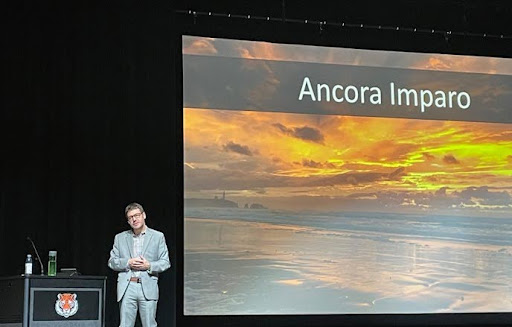
Sorenson explained that the district partnered with the Boettcher Foundation to dedicate time toward learning about responsible AI use. Through this partnership, GJHS hosted AI expert Tim Creasey, chief innovator of Prosci, on Oct. 9, 2025.
Creasey, a 1997 GJHS graduate and Boettcher Scholar, delivered a presentation titled “Unlock Your Human Potential: Partnering with Your AI Intern.” He focused on achieving change with and through people, emphasizing that AI should enhance human potential rather than replace it. Sorenson noted that Creasey closed his speech with a quote often attributed to Michelangelo, meaning, “I’m still learning,” reinforcing the idea that growth and adaptability remain essential in an AI-driven world.
Therriault agreed that AI could potentially impact classrooms positively, but only with clear limits.
“Probably,” she said. “I’m sure there are ways we could work hand in hand with AI without sacrificing the growth
and well-being of the child. Although I think there have to be hard boundaries to help guide students.”
She added that her perspective might be different if she did not work with adolescents.
This approach reflects a broader recognition that the challenge is not whether AI will be used, but how it will be integrated in ways that preserve academic integrity, developmental growth, and student creativity.